Evaluating the Italian Food Pattern Bundle Hand-Drawn for Professional Design Work
In the current landscape of digital design and print-on-demand commerce, there is a distinct shift away from sterile, vector-perfect graphics toward assets that convey warmth and human touch. Consumers are increasingly drawn to visuals that suggest artisanal craftsmanship, nostalgia, and authenticity. Within this context, the Italian Food Pattern Bundle Hand-Drawn emerges as a significant resource for creators seeking to infuse their projects with Mediterranean charm without sacrificing technical quality. This collection is not merely a set of clipart; it is a curated suite of seamless patterns designed to bridge the gap between traditional illustration techniques and modern digital workflows.
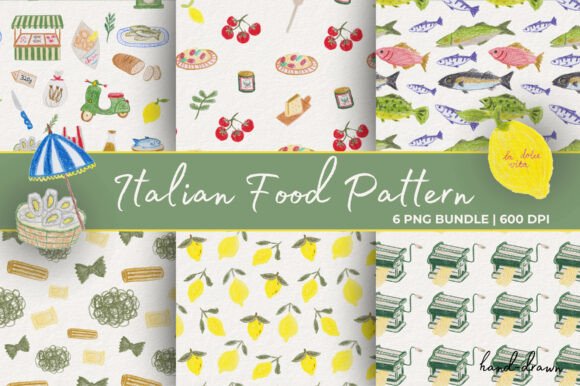
The core appeal of this bundle lies in its specific aesthetic execution. Unlike many pattern packs that rely on flat colors or rigid geometric repetitions, these files utilize a colored pencil illustration style. This approach introduces soft, textured edges and subtle variations in color coverage that mimic the behavior of graphite and pigment on paper. For designers, this means the difference between a generic background and a piece of art that feels tactile and inviting. The inclusion of six transparent PNG files, each rendered at 4000 x 4000 pixels with a resolution of 600 DPI, ensures that the artwork remains crisp whether it is being used for a small wedding invitation or a large-scale textile print.
Technical Specifications and Asset Quality
When evaluating digital assets for professional use, resolution and file format are paramount. The Italian Food Pattern Bundle Hand-Drawn meets high industry standards by providing 600 DPI files. This is particularly crucial for physical products. Many standard stock patterns hover around 72 or 300 DPI, which can result in pixelation when printed on fabrics or heavy cardstock. At 600 DPI, these patterns offer a safety margin for scaling, allowing users to adjust the repeat size without losing the integrity of the colored pencil texture.
The choice of PNG format with transparency is equally strategic. It allows designers to layer these patterns over different background colors or integrate them into complex compositions without dealing with unwanted white boxes or rigid boundaries. The seamless nature of the files means they can be tiled indefinitely in software like Adobe Photoshop, Illustrator, or Procreate, creating continuous backgrounds for websites, wrapping paper, or fabric rolls. However, users should note that the "hand-drawn" description is literal. The edges are intentionally soft and uneven, and color coverage may vary slightly across the stroke. These are not defects but characteristic features of the medium that contribute to the overall organic feel.
Thematic Versatility and Visual Narrative
The thematic scope of this bundle extends beyond simple food icons. It captures the essence of an Italian market and kitchen life. The inclusion of lemons, pasta varieties, fresh fish, tomatoes, and various kitchen motifs provides a cohesive visual language. This consistency is vital for branding projects where a disjointed aesthetic can undermine credibility. For instance, a restaurant menu using these patterns can create a unified identity from the cover design down to the section dividers.
The color palette inherent in the colored pencil style tends to be softer and more muted than digital vectors, which often aids in readability when text is overlaid. A pattern featuring dense, saturated reds might overwhelm a recipe card, but the textured, semi-transparent application of color in this bundle allows typography to remain legible. This makes the Italian Food Pattern Bundle Hand-Drawn particularly effective for editorial design, such as cookbooks, food blogs, and culinary magazines, where the image must support rather than dominate the content.
Practical Applications Across Industries
The utility of this asset pack spans several industries, offering specific value propositions for different types of creators:
- Textile and Surface Design: The high resolution and seamless construction make these patterns ideal for fabric printing. Whether for aprons, table linens, or fashion textiles, the organic texture prevents the "digital repeat" look that often plagues mass-produced fabrics.
- Packaging and Branding: Small batch food producers, such as artisanal pasta makers or olive oil bottlers, can utilize these graphics for labels and boxes. The handmade aesthetic aligns perfectly with brands that emphasize natural ingredients and traditional methods.
- Stationery and Paper Crafts: For scrapbookers and journal enthusiasts, the nostalgic quality of the illustrations adds emotional depth to memory-keeping projects. They are well-suited for recipe journals, travel logs of trips to Italy, or family history books.
- Print on Demand (POD): Sellers on platforms like Etsy, Redbubble, or Society6 can leverage these patterns for home decor items. Kitchen towels, wall art, and tote bags featuring these designs tap into the evergreen popularity of cottage-core and farmhouse decor trends.
Workflow Integration and Usability
From a workflow perspective, the immediate usability of these files saves considerable time. Creating hand-drawn seamless patterns from scratch requires significant artistic skill and hours of labor to ensure the repeat is invisible and the texture is consistent. By utilizing the Italian Food Pattern Bundle Hand-Drawn, freelancers and agencies can bypass the illustration phase and move directly to layout and composition. This efficiency allows for faster turnaround times on client projects.
Furthermore, the flexibility of the PNG format allows for easy manipulation. Designers can adjust the opacity, apply blending modes, or recolor elements (within the limits of the texture) to match specific brand guidelines. While the files are ready-to-use, they also serve as excellent base layers for mixed-media projects, where digital elements might be combined with scanned papers or other textures to create a unique collage effect.
Considerations and Limitations
While the bundle offers substantial value, it is important to manage expectations regarding the style. Users accustomed to clean, sharp vector lines may initially perceive the soft edges and texture variations as a lack of precision. It is essential to understand that these characteristics are intrinsic to the colored pencil simulation. If a project requires ultra-modern, sleek, or corporate aesthetics, this rustic, warm style may not be the appropriate fit. Additionally, because the patterns are raster-based (pixels) rather than vector-based, infinite scaling is not possible without eventual quality loss, although the 4000px starting point mitigates this for most standard commercial uses.
Another consideration is the specificity of the theme. While "Italian food" is a broad and popular category, the specific motifs included (lemons, pasta, fish) dictate the narrative. Designers working on projects requiring non-food Italian imagery, such as architecture or landscapes, would need to supplement this bundle with other assets. However, within its niche, the coherence of the set is a strength, ensuring that all elements work harmoniously together.
Final Assessment on Value and Longevity
The Italian Food Pattern Bundle Hand-Drawn represents a smart investment for creatives who prioritize authenticity in their visual communications. In a market saturated with generic digital art, the ability to offer a product that feels handmade and soulful is a competitive advantage. The technical specifications support professional output, while the artistic style connects emotionally with audiences seeking warmth and tradition.
For small business owners, the cost of acquiring such a bundle is negligible compared to the cost of commissioning custom illustrations, yet the perceived value added to the final product is significant. For hobbyists, it provides access to professional-grade tools that elevate personal projects to a polished standard. As long as the trend toward artisanal, human-centric design continues, assets that successfully replicate traditional media in a digital format will retain their relevance and utility. This bundle stands as a reliable, versatile, and high-quality tool in the modern designer's toolkit.